
October Capability Building Event - LRF/VCS Connections

For October’s Capability Building Event, we explored the connections between Local Resilience Forums (LRFs) and the Voluntary and Community Sector (VCS). This is a topic that regularly comes up in discussions with partners from emergency response specialists to local infrastructure. We were joined by four guests to talk about their experiences, both from the point of view of a VCS organisation, and that of an LRF. Our speakers were:
Sam Samwell - Senior Emergency Response Officer (North West), British Red Cross
Bethan Morgan – Director, Staffordshire Civil Contingencies Unit
Michelle Cliff – Senior Development Manager, Support Staffordshire
Ben Wilding – Emergency Planning Officer, Suffolk Local Resilience Forum
Below you can find summaries of their presentations.
The second part of the event gave partners space to discuss the successes and challenges in their experience of LRF/VCS partnership working. It was fascinating to hear from a range of perspectives including VCS organisations, local government and LRFs themselves. From those conversations, we found that five key themes and topics arose. You can find these below along with some points to consider for both the VCS and LRFs.
-
Sam talked us through his experience - as the British Red Cross and VCS representative - of the tri-LRF cross-boundary working of Durham and Darlington, Cleveland and Northumbria LRFs.
The good relationships between the LRFs and the VCS are reflective of the seven years of consistent relationship building from Sam. The three LRFs also have strong relationships with each other and regularly hold cross-border training and share good practice.
Sam has established the Voluntary Emergency Liaison Group (VELG), a subgroup of the LRF which ensures a voice for the VCS. With Sam as chair for all three, there is continuity and knowledge shared. Within the VELG are local representatives, but also cross-regional organisations like Salvation Army and St John Ambulance.
One of the biggest challenges is receiving the call outs through the Blue Lights Services and the Civil Contingencies Unit. Developing close relationships with the Civil Contingencies Unit Duty Managers has helped them become closer as a first port of call.
-
Bethan and Michelle spoke about their joint approach to developing community resilience and relationships between the Civil Contingencies Unit (CCU) and the VCS.
Staffordshire LRF is funded by its partners as an active and operational LRF, with VCS organisations embedded at strategic level including Support Staffordshire who have been involved in the LRF for several years.
Post-Covid, the visibility and role of the VCS has changed, and there is appetite to reflect this by reviewing LRF and VCS engagement and structures.
The CCU developed the following principles:
• Where possible, to invest and buy-in capability from local organisations.
• Work with experts in the field to co-design the solution and a partnership approach to delivery.
Together with the CCU, Support Staffordshire have embarked on a project to strengthen the role of the VCS to deliver a sustainable and responsive structure. The project will work with key stakeholders to review and reinvigorate the local VCSE response network, reviewing VCSE capabilities and plans for managing spontaneous volunteers.
Both Michelle and Bethan reflected on the positive impact made by a genuinely co-designed approach, using experts in the VCS and with responsibility sitting across both parties.
-
Ben spoke about the work Suffolk LRF have been doing this year to build community resilience.
Along with a range of partners, they attended the Suffolk County Show, distributing merchandise and emergency preparedness guides, engaging with the public, explaining more about their work and educating people on how they could increase their personal preparedness and resilience and therefore community resilience.
Ben addressed how previous LRF structures had focussed on emergency response specialists from the VCS, but they have found that often, non-emergency specific VCS organisations play a significant role in planning and recovery. Therefore, Suffolk LRF wants to create a new model that can enhance information flow to and from LRFs and the wider VCS, allowing the LRF to better understand the capabilities of the sector.
They have already begun holding workshops with the VCS and have had positive feedback on the new approach.
Key Themes

Questions to Consider:
LRFs - How could LRFs adapt to better understand and draw in the wider VCS? How could Category 1 and 2 responders be supported to engage with the VCS in VCS-held spaces?
VCS – What can be done to better inform LRFs of the capabilities of the VCS, outside of emergency response organisations?

Questions to Consider:
LRFs – How would be the best way for VCS organisations to keep you and any capability matrices updated?
VCS – How often do you update your LRF of any changes in capabilities? Could you schedule this for every quarter or every six months even if there have been no changes?

Questions to Consider:
LRFs – How often do you meet with VCS representatives? Are these solely emergency response organisations, or is the wider VCS present at these meetings?
VCS – Do you engage with your LRF outside of an incident or response? Could more frequent interactions help build better connections?
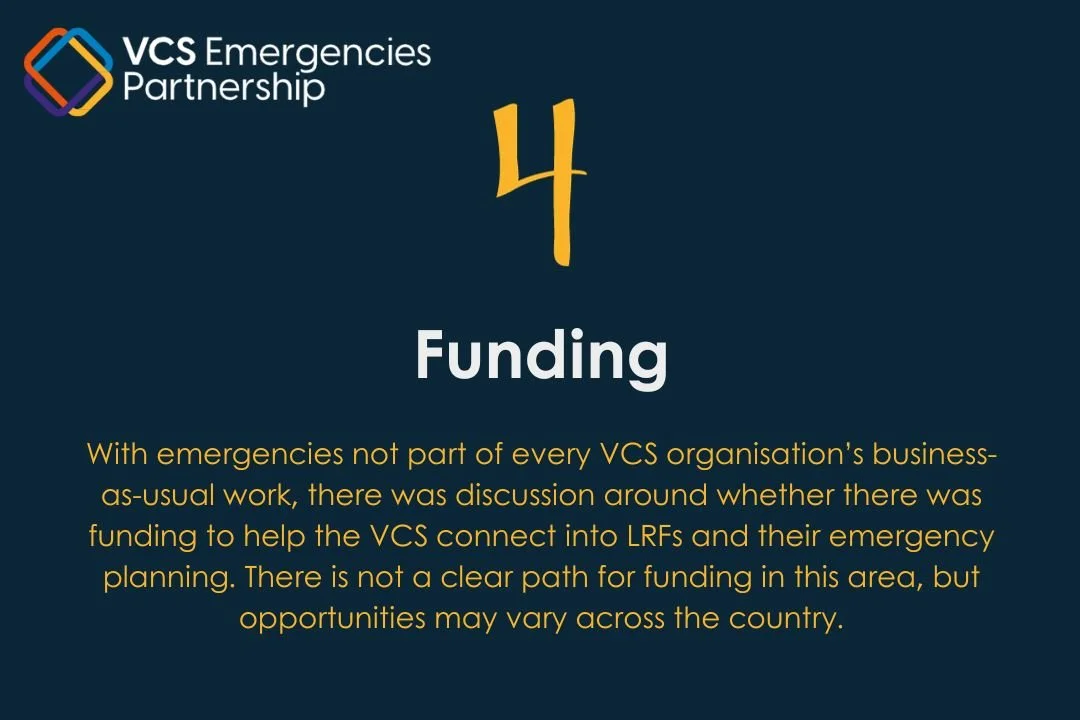
Questions to Consider:
LRFs – Are you aware of if there is funding available for your local VCS? How could you make it easier for the sector to engage?
VCS – Check with your LRF as to whether there is funding available. What would make it easier to allocate time to building LRF-VCS connections?

Questions to Consider:
LRFs – When you conduct training and exercising, which VCS organisations do you involve? If it is only emergency response specialists, could this be opened to the wider sector?
VCS – What exercising are you involved in within your community, do you invite or inform the LRF of this?
Resources and Recommended Reading
Groundwork and the British Red Cross have partnered for a programme that aims to set up community resilience hubs across the UK. Read more about it here.
Cumbria LRF is developing a digital tool that searches multi-partner data sources to allow the rapid identification of vulnerable households in an emergency. Read about its development here.
NHS England and NCVO developed this reference guide, aiming to help voluntary or public sector leaders build successful, sustainable and effective partnerships.
New Local is a network of councils and has conducted research exploring how councils and communities joined together to respond to Covid-19, with recommendations for how to take forward the innovation and collaboration that emerged during this time. Read ‘Shifting the Balance’ here.