
LGA Conference 2026 Bournemouth - What If Resilience Is the Real Story?
7 minute read.
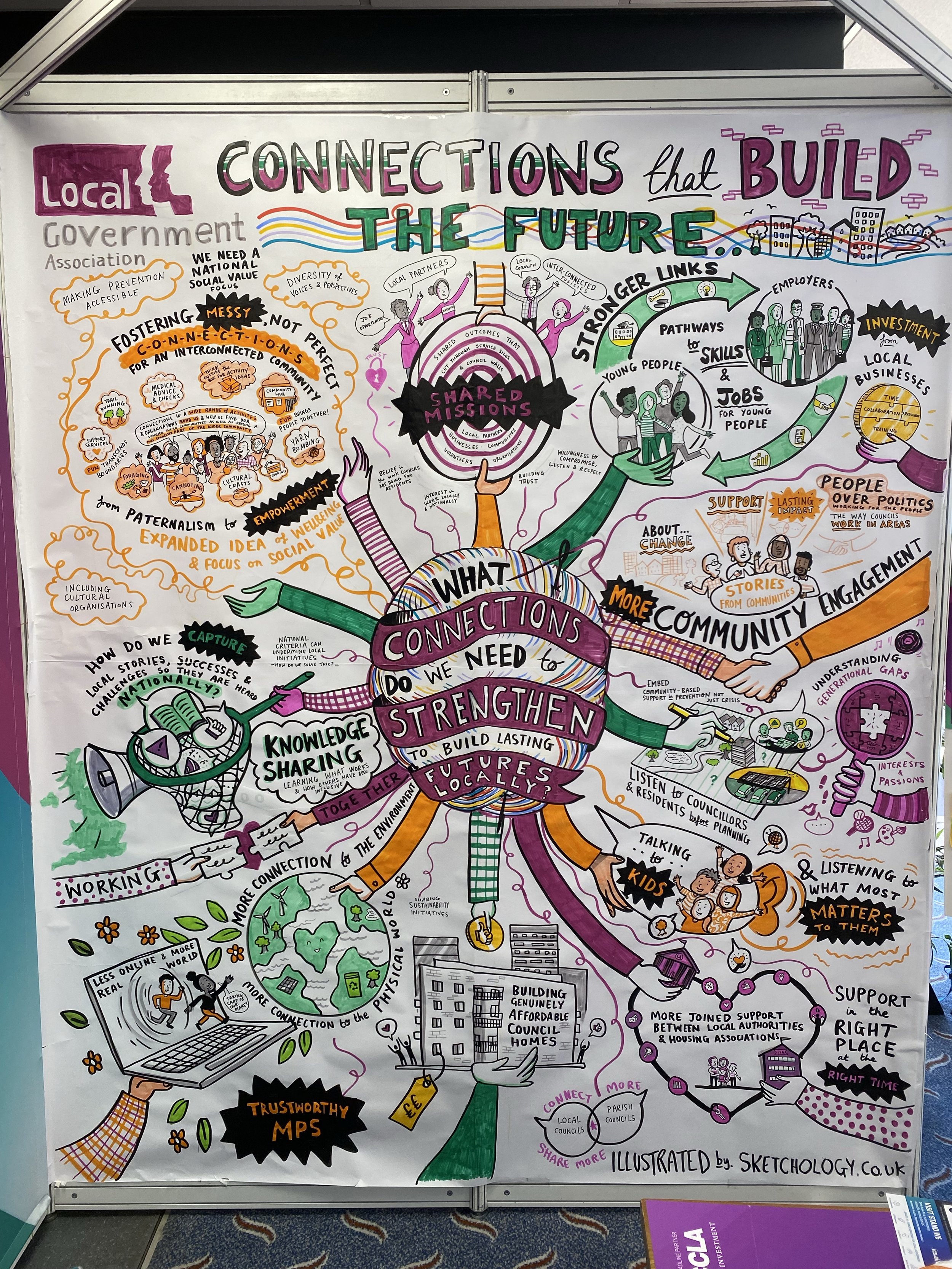
In this blog, our Policy and Insight Lead, Tom Watkins, reflects on key themes emerging from the Local Government Association Annual Conference in Bournemouth. While discussions ranged from devolution and public service pressures to community tensions and reform, Tom argues that a common thread ran through them all: resilience. Drawing on conversations with local leaders and examples from across the conference, he explores why strong relationships, trust, community leadership and partnership working are critical to helping communities navigate uncertainty and thrive in the face of future challenges.
There is something reassuring about gathering thousands of people together who care deeply about the places they serve.
Last week, more than 2,500 councillors, chief executives, officers, charity representatives, a sprinkling of community organisations and other partners came together in Bournemouth for the Local Government Association's Annual Conference. It is one of the few places where such a broad cross-section of local leadership can share the same space, wrestle with the same questions, disagree in relative safety, and, just occasionally, discover that they agree more than they’d openly admit.
And there were certainly plenty of juicy topics to ponder.
Local government reform. Devolution. Public service pressures. The future for young people. Economic uncertainty. Community tensions. Demand rising faster than resources. You could feel the weight of those challenges in conversations throughout the conference. They created a productive tension: a room full of people grappling with difficult questions that matter deeply to the places they serve. When contentious issues were raised, passions sometimes spilled over and sparks occasionally flew, but so too did moments of genuine curiosity, challenge and engagement. In an era where so many conversations happen at a distance, there was something reassuring about people leaning into disagreement rather than avoiding it.
Yet one of the things that stayed with me most was not a policy announcement or any of the many political speeches.
It was the recurring recognition that strong communities depend on strong relationships.
Speakers from different areas, different sectors and different viewpoints returned to remarkably similar themes. They talked about local knowledge. Trusted partnerships. Community leadership. The importance of creating spaces where people feel heard. The need to move upstream and prevent problems rather than continually responding to crisis.
One speaker put it bluntly: “things don’t change because we have a fancy transformation programme. They change because people care enough to make them better.”
The same sentiment surfaced throughout the conference, but rarely was it expressed so simply or so powerfully.
And yet there was a noticeable disconnect for me.
Many of the challenges being discussed, whether around public trust, health inequalities, extremism, volunteering, emergency preparedness or community tensions, ultimately came back to the same underlying issue: resilience. I would say that wouldn’t I? I work for a resilience focused organisation!
Well, it’s true! I don’t mean resilience in the narrow sense of how good we are at responding to emergencies, but the wider durability of communities when dealing with the many challenges of the present time. The strength of local relationships. The ability to navigate disagreement productively and respectfully. The confidence to solve problems together. The sense that people have agency, belonging and a stake in the places where they live.
It was there in almost every conversation. But it was rarely named and I found myself wondering how many attendees actually noticed?
The sessions that dealt most directly with cohesion and resilience all arrived towards the end of the conference programme, unfortunately when many delegates were already heading home. A couple of these ran simultaneously, forcing attendees to choose between topics that arguably deserved a much wider audience.
That is not a criticism. If anything, it reflects a challenge for all of us.
We all know these issues matter. We know they underpin so many of the other challenges we face. The question is whether we are giving them the attention and the space they deserve.
Fortunately, there were reasons for optimism.
One of the most powerful sessions focused on building community cohesion from neighbourhoods up. There were no grand solutions or silver bullets. Instead, speakers returned to something both simpler and more difficult: building trust.
Emeka Forbes, Director of the Together Coalition and Secretariat Director for the Independent Commission on Community and Cohesion, shared a simple yet powerful personal story that has stayed with me. Travelling into London on the day of the "Unite the Kingdom" protests, he found himself in a packed and noisy train carriage surrounded by flag-draped demonstrators. As a mixed-race man, he admitted he felt uneasy as one protester began pushing directly towards him through the crowd. He braced himself for confrontation. Instead, the concerned individual handed back a pair of glasses Emeka had dropped moments earlier and the two went on to have a friendly conversation. It was a simple act of kindness, but a powerful reminder of how often we fill the gaps in our knowledge of one another with assumptions. At a time when division can feel amplified, his story spoke to something deeper: the importance of creating opportunities for people to encounter one another as individuals rather than caricatures, and to find common ground where they least expect it.
That sort of thing that rarely makes headlines. But perhaps that is a part of the problem?
If we are serious about building stronger communities, we need to get better at noticing, nurturing and celebrating those moments of connection. The times when the space between us narrows.
Throughout the conference there were repeated calls for local authorities, voluntary organisations, health services, businesses and communities themselves to work more closely together. Not because partnership is fashionable, easy or necessarily cost effective but because the problems facing places are too complex for any one organisation to solve alone.
That felt particularly important at a time when so many of our public institutions are experiencing profound change. Local Government Reorganisation, ongoing reforms across the NHS, further structural changes on the horizon for policing. Let's not forget national political leadership that seems to turn over faster than many strategic plans can be delivered.
Structures evolve. Boundaries shift. Organisations merge, divide and reorganise. Leaders arrive with new priorities and hand them over to the next generation before they’ve seen them through. Yet through all of this, communities remain.
Far from being untouched by change, so many places are carrying the weight of economic limitation, rising demand, social pressures and a growing sense of frustration with institutions. But communities somehow endure. They adapt. They continue to support one another, often with little fanfare and meagre resource. Within communities sits an extraordinary reserve of local knowledge, relationships, experience and memory that survives many iterations of organisational charts and boundary lines being redrawn.
That, for me, was one of the most important lessons from Bournemouth. When public systems are navigating uncertainty, our instinct can be to focus upwards on the structures, strategies and governance. All of those things matter. But we shouldn’t lose sight of the fact that resilience ultimately lives closest to the ground.
Another lasting reflection came from a conversation I had at the end of the conference about hope.
Not the comforting version of hope that passively assumes everything will work out eventually. The demanding version. The version that requires us to acknowledge the challenges honestly while refusing to accept that division, mistrust or disengagement are inevitable. The version that asks organisations to:
invest in relationships before they are needed,
to share power more freely, because it’s the right thing to do, not because you want someone else to blame
to listen more deeply
and to create more opportunities for people to contribute to the places they call home.
Robin Tuddenham's recent article, Leading in the Age of Anger, argues that one of the defining leadership challenges of our time is responding to rising frustration, distrust and polarisation without becoming consumed by them. That felt highly relevant to many of the conversations taking place at the conference. In an age where anger is often amplified, and malign intentions drive in wedges and turn up the heat, leadership increasingly requires us to create the conditions for connection, agency and belonging.
And that is where the hope comes in.
Hope isn’t passive optimism. It’s the choice to believe that things can be better, taking a leap of faith to trust others with achieving that vision and then doing the hard work together required to make them so.
Resilience, cohesion and community strength cannot be left to chance. They have to be nurtured. They have to be prioritised. And they have to be built together.
In the years ahead, our institutions will undoubtedly continue to change. Communities will face new pressures and new uncertainties. But if local government, civil society, businesses and residents can continue to invest in one another, strengthen relationships and celebrate every act of connection, there is every reason to believe our communities can do more than simply weather the storm. They can help shape a stronger, more resilient future.