
Are We Ready? VCS Emergencies Partnership Reflections on the House of Lords National Resilience Committee Report
8 minute read.
By Tom Watkins, Policy & Insight Lead at the Emergencies Partnership.
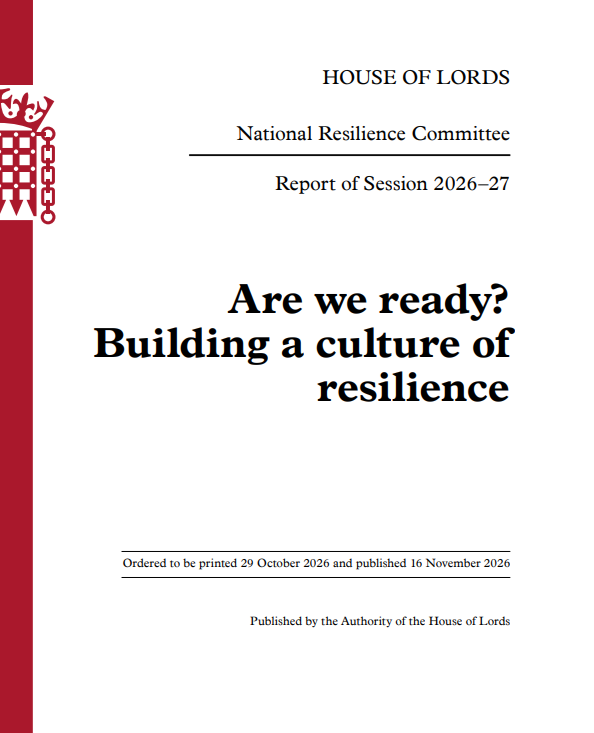
The House of Lords National Resilience Committee's Inquiry report, Are We Ready? Building a Culture of Resilience (published on 16th November 2026), is likely to become an important reference point in discussions about the future of UK resilience policy. The 102-page report is the result of a year-long inquiry involving government, emergency services, businesses, academics and civil society, examining how well prepared the UK is for a future characterised by increasingly complex and interconnected risks.
The VCS Emergencies Partnership (EP) contributed directly to the inquiry, providing both written and oral evidence. Evidence was presented on behalf of the partnership at a public session on 23rd April, and further public sessions which were attended by partners were directly informed by EP briefing and engagement. The report therefore reflects many of the issues, challenges and opportunities that organisations across the voluntary and community sector have been highlighting for some time.
The headline conclusion is straightforward: the UK's approach to resilience remains too fragmented, too siloed and too reactive. The Committee argues for a stronger whole-of-society approach that brings together government, businesses, communities and civil society before crises happen, not just during them.
On much of that, we'd strongly agree.
What we welcome most is the report's recognition that civil society is not an "emergency add-on" but part of the country's standing resilience capability. That's a point many organisations across the sector have been making for years, and it is encouraging to see it reflected so clearly.
A stronger role for civil society
The report is also right to highlight the challenges facing local resilience. Effective partnerships, trusted relationships and local capability take years to build. They cannot be sustained through short-term funding cycles or maintained solely through goodwill. The recommendation for more consistent and predictable investment in local resilience deserves serious attention.
We particularly welcome the Committee's timely support for strengthening the role of civil society within resilience arrangements. It has been a widely held view for many years, across the resilience sector that voluntary, community and faith organisations should be recognised as an integral part of the resilience system, not simply organisations to be engaged when needed. The Committee's endorsement of stronger legislative duties to involve civil society in resilience planning reflects that long-standing position.
Communities, charities, businesses and public services all have a role to play in preparedness, response and recovery. At the EP we believe embedding partnerships with civil society more firmly within the Civil Contingencies Act 2004 would help create a more consistent foundation for local resilience. It would also better reflect the reality that resilience is built through collaboration across sectors rather than within any one part of the system.
With a formal review of the Civil Contingencies Act 2004 currently underway, we hope this recommendation gains traction.
Communities are the foundation of resilience
One of the strongest themes running through the report is the principle that resilience is built locally. Throughout the inquiry, the Committee emphasises community capability, local leadership, trusted relationships and subsidiarity. In other words, decisions should be taken as close as possible to the people and places affected by them.
That is where many of the report's strongest recommendations sit.
One area where we would have liked the report to go further is in recognising the connection between resilience and the wider health of communities. Resilience is sometimes discussed as though it sits alongside issues such as poverty, poor health, loneliness, pressure on local authorities, pressure on voluntary organisations and volunteer fatigue. In reality, these things are deeply connected. Communities facing sustained social and economic pressures often have less capacity to absorb shocks, recover from disruption and participate in resilience-building activities. A whole-of-society approach needs to grapple more directly with these realities. Communities are not starting from a blank sheet of paper. They are significant contributors to building and maintaining everyday resilience. But we need to recognise that they are already carrying significant pressures, and those pressures influence what participation, preparedness and resilience look like in practice.
An unresolved tension
Running through the report are two very different ideas about how resilience is built.
The first, and in our view the stronger, is that resilience grows from the ground up through communities, local partnerships, trusted relationships and capable local institutions.
The second looks to solve challenges through new national structures, systems and coordination mechanisms.
The report moves between these two approaches without fully reconciling them.
Choices that are made on the back of these recommendations will influence where resources, attention and authority end up. The Committee makes a compelling case for building resilience through community capability, participation and local partnerships. Yet some of its proposed solutions to the national tier of government risk drawing attention away from those same strengths.
Volunteering and preparedness
The tension is most visible in the recommendation to create a national register of volunteers and civil reservists.
The report is absolutely right to recognise volunteering as a vital part of national resilience. Recent emergencies have shown that people are willing to step forward and support their communities when needed.
Across the country, people are already contributing to resilience every day through charities, faith groups, volunteer centres, community organisations and emergency response partners. Whether explicitly labelled as resilience activity or not, these networks are building skills, agency, trust, relationships and community capability long before a crisis occurs. Much of this work happens quietly and successfully, often without national visibility.
Sustainable preparedness depends on people remaining connected, involved and able to contribute over months and years. That means creating meaningful opportunities for participation, building confidence and capability, and giving people clear pathways into activity that strengthens resilience before disruption occurs.
The circumstances that drove engagement during the COVID-19 response were unique. There was a visible national emergency, a strong sense of shared purpose and an immediate demand for support. Sustaining that level of engagement in a state of preparedness would require significant ongoing investment and attention.
There is a real risk of disengagement. People do not join volunteering initiatives to sit on a list waiting for something to happen. Skills, availability, motivations and personal circumstances change constantly. Without a responsive system that makes people feel useful, they quickly lose interest, lose confidence in the system and become less likely to respond when called upon. Maintaining an accurate picture of a volunteer's capabilities, experience and circumstances is challenging even for organisations that work with them regularly. Local organisations, partnerships and volunteer managers are far better placed to understand who people are, what they can offer and how best to support their involvement over time.
There is a significant risk that a new national structure would duplicate, compete with or draw resources away from the networks and partnerships already doing this work successfully locally.
Our focus should be on strengthening what already exists: connecting organisations more effectively, addressing service gaps, removing barriers to participation, and creating more opportunities for people to play an active role in building resilience within their own communities.
Building resilience through active participation
There is a broader point here. The report rightly calls for greater public preparedness, but preparedness is not simply about well-publicised awareness campaigns or plans. Resilience grows when people know what to do when disruption occurs, trust the people and organisations around them, and feel confident acting when action is needed.
That confidence and agency are built through participation. They are built by involving people in resilience, not simply preparing them for it.
For us, one of the most important questions raised by this report is how we better connect the capability that already exists. Fragmentation is not confined to government structures. It can be found between sectors, between organisations and sometimes even within the resilience system itself. Stronger resilience will come from stronger connections: between local and national partners, between public services and communities, and between the many organisations already contributing to resilience every day.
Looking ahead
Overall, this is an important and timely report. It presents a serious endorsement of the role that communities, voluntary organisations and wider civil society play in national resilience. Where it focuses on relationships, trust, participation and local capability, it is particularly compelling.
The next challenge is ensuring that any future reforms build on those foundations: strengthening local partnerships, investing in connecting existing capability and creating more opportunities for people, organisations and communities to contribute to resilience long before the next crisis arrives.